Why Lead Outlasts Copper and Rubber

Copper looks like the obvious upgrade material — it’s specified on plenty of historic and high-end projects, and it has a reputation for longevity on standing-seam roofs. The problem is that copper work-hardens. Every thermal cycle, every settlement movement, every bend you make in the field adds residual stress to the sheet. Over time that stress accumulates at the tightest bends — which on a chimney means the step flashings and the apron crease.
Field failure on copper chimney flashing typically shows up as hairline cracking along step bends, ten to twenty years after installation. Once the crack starts, water gets in and the underlying decking degrades faster than the flashing itself.
Rubber-based flashing systems — EPDM, butyl tapes, modified bitumen patches — fail the same way exposed polymer sealant fails: UV breaks down the binder, thermal cycling separates the membrane from the substrate, and within ten to fifteen years the bond is gone. On a chimney, where the south face takes direct sun and the north face cycles through freeze-thaw, the failure timeline compresses further.
These systems make sense as a temporary patch. They are not a permanent specification.
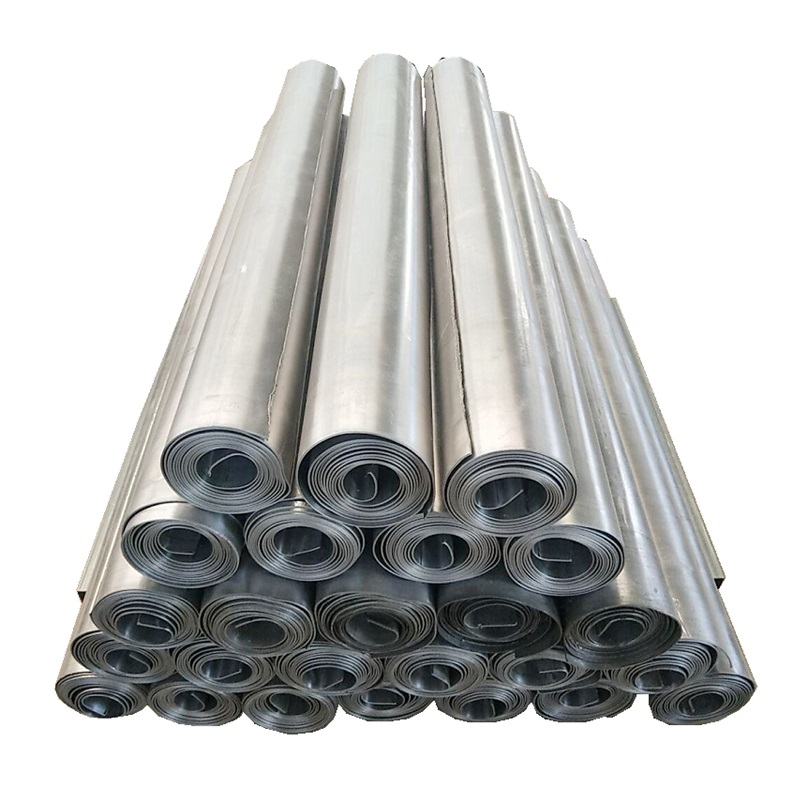
Lead sheet behaves differently from both. It does not work-harden under normal thermal cycling — soft lead continuously yields under stress, which means a step flashing that gets pushed by settlement or thermal movement reforms its shape rather than cracking. It conforms permanently to the masonry profile, including the irregularities you don’t catch in the field. And because it’s chemically compatible with lime mortar and Portland cement, you don’t get the bimetallic corrosion you see when aluminum or galvanized steel sits in a wet masonry joint.
A properly installed lead counterflashing — step flashing into the courses, counterflashing locked into a reglet or mortared joint — has a documented service life of 50 years and beyond. That’s roughly two to three full cycles of copper or rubber for the same chimney.
Lead Sheet for Gasket Applications: Why Soft Lead Works for Sealing Joints
Lead Sheet (Lead Plate): Key Properties & Common Industrial Applications